An AI copilot in the maintenance technician's pocket.
HappyCo already brings JoyAI into maintenance workflows through intake, summaries, routing, voice capture, and operational insights. Field Copilot explores the next layer: a technician-facing intelligence surface that helps teams document less, catch patterns earlier, and turn every repair into structured portfolio memory.
The goal: reduce form burden for technicians while turning every repair into structured portfolio intelligence.
Three sentences.
The system connects the dots.
Marcus walks into Unit 3B, taps the mic, and describes what he sees. JoyAI captures the note, structures the work order, and surfaces the context a single technician would not have in memory: this is the third leak in the same vertical stack this month.
A day in five screens.
Each screen lives at a different moment of the technician's day. The same AI signal follows the work from route planning to capture, review, escalation, and day wrap — always marked by the ✦ cyan accent so the user knows when the system is making a suggestion.
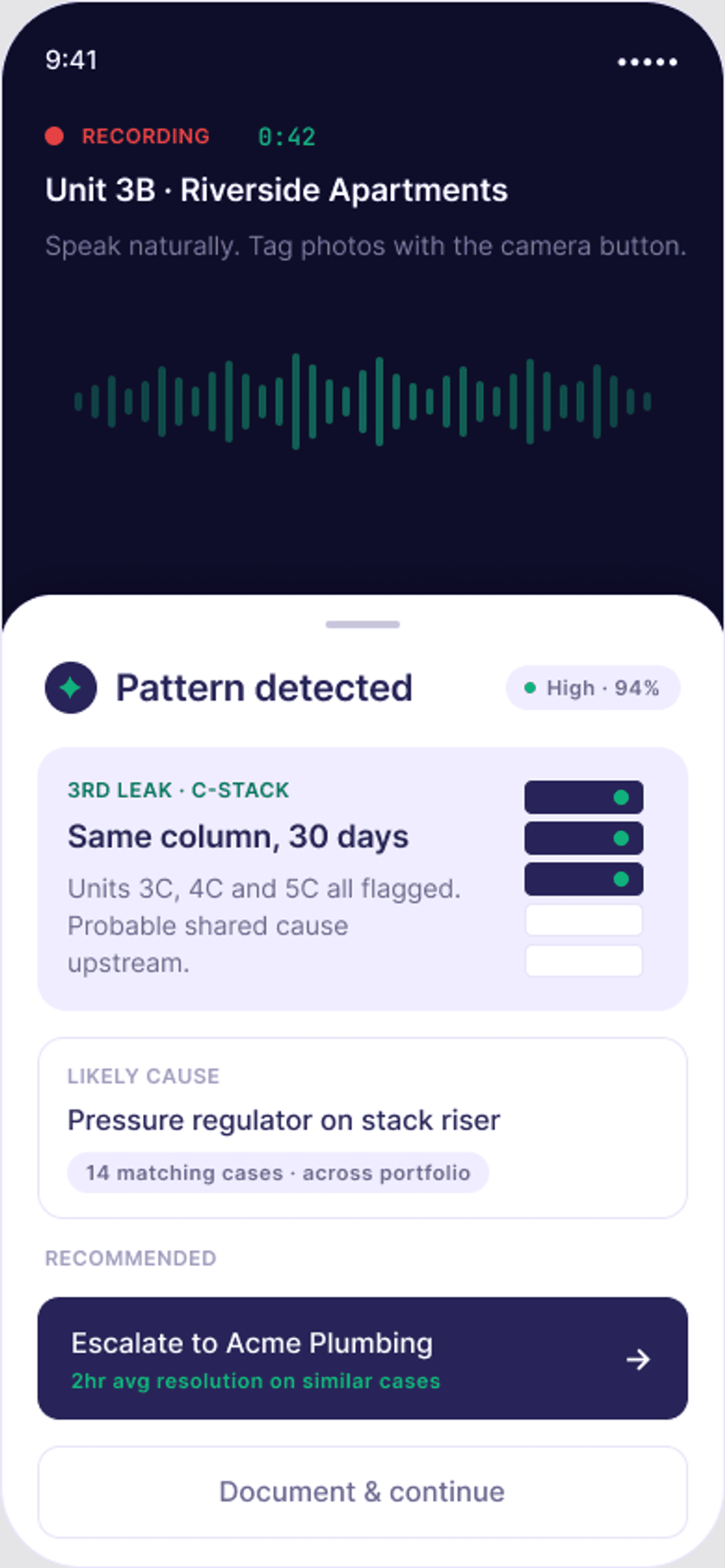
Pattern detected.
The moment that matters. The AI sees what the technician can't: a recurring pattern across the portfolio, a likely root cause, a vendor who's solved this before.
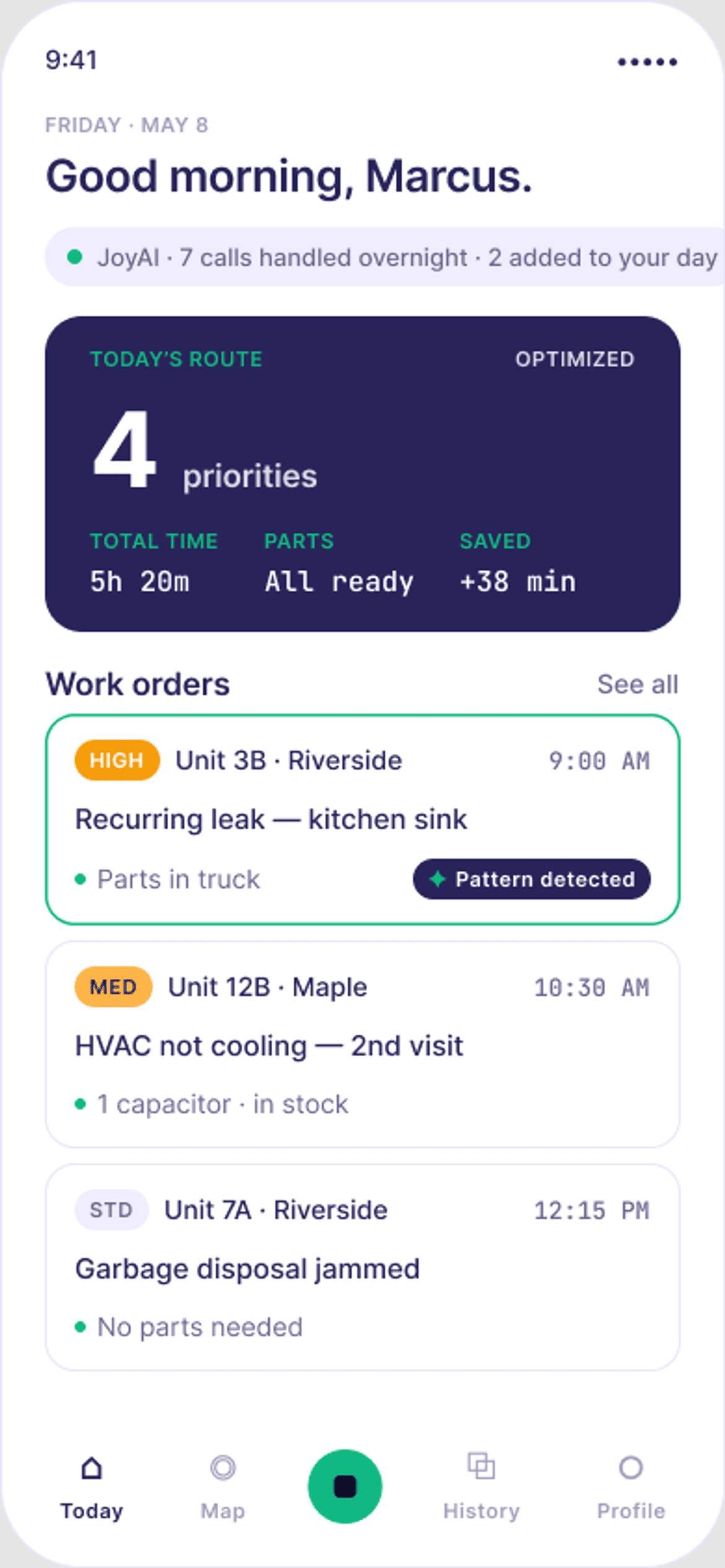
JoyAI has already triaged overnight intake; today's route is optimized, parts are pre-staged, and the top risk is flagged.
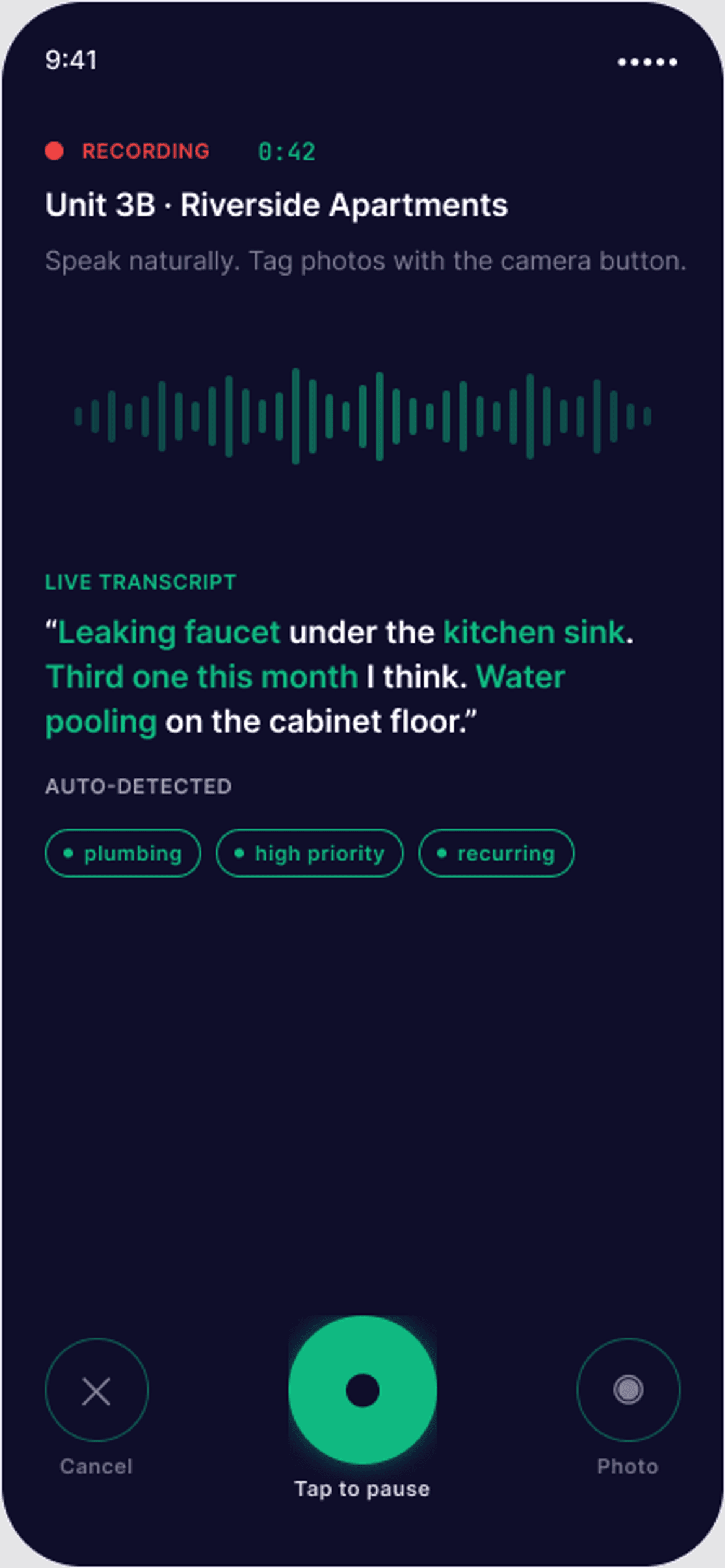
Voice in the unit. Transcription parses entities live. Three sentences become structured fields, suggested tags, and portfolio context.
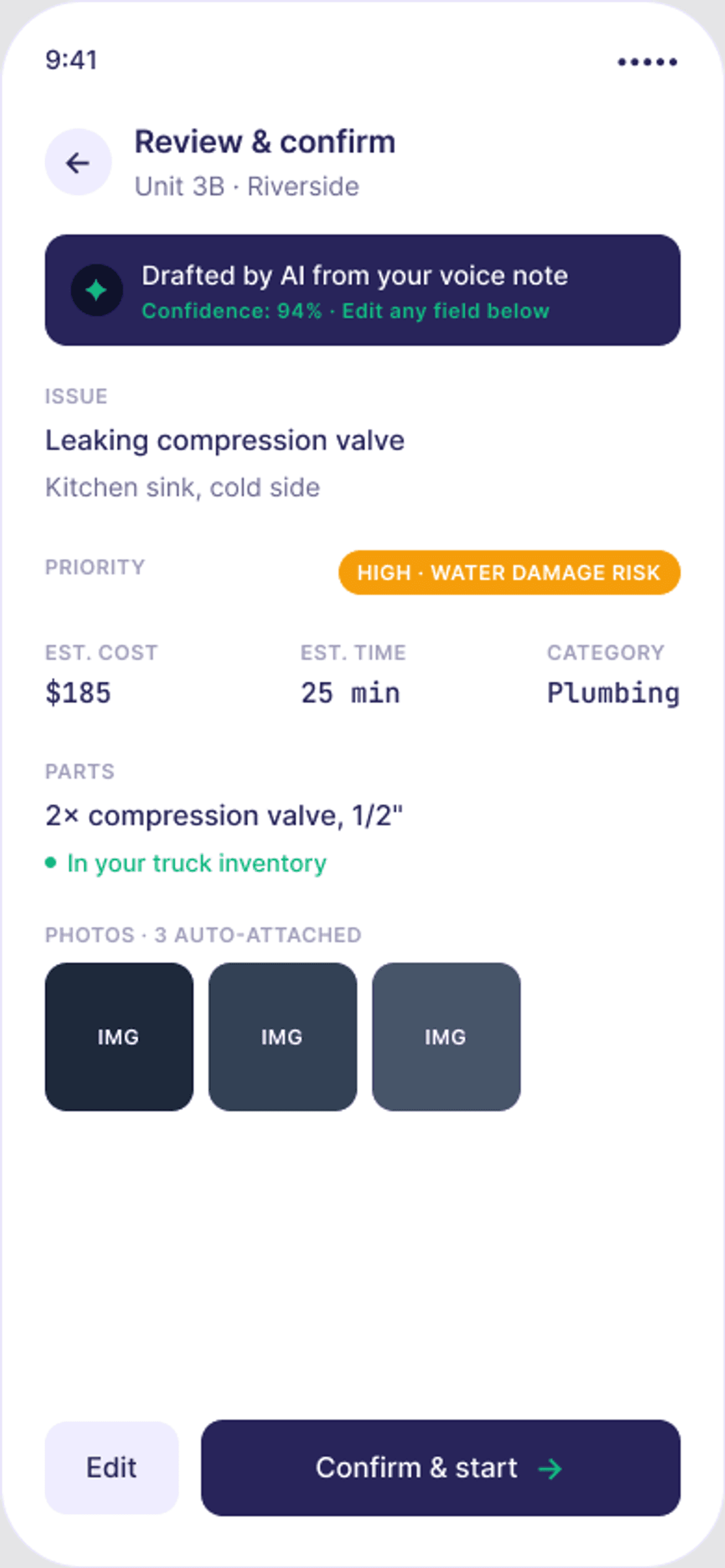
The work order, drafted. Confidence shown openly, every field editable. Parts checked against truck inventory. Photos auto-attached.
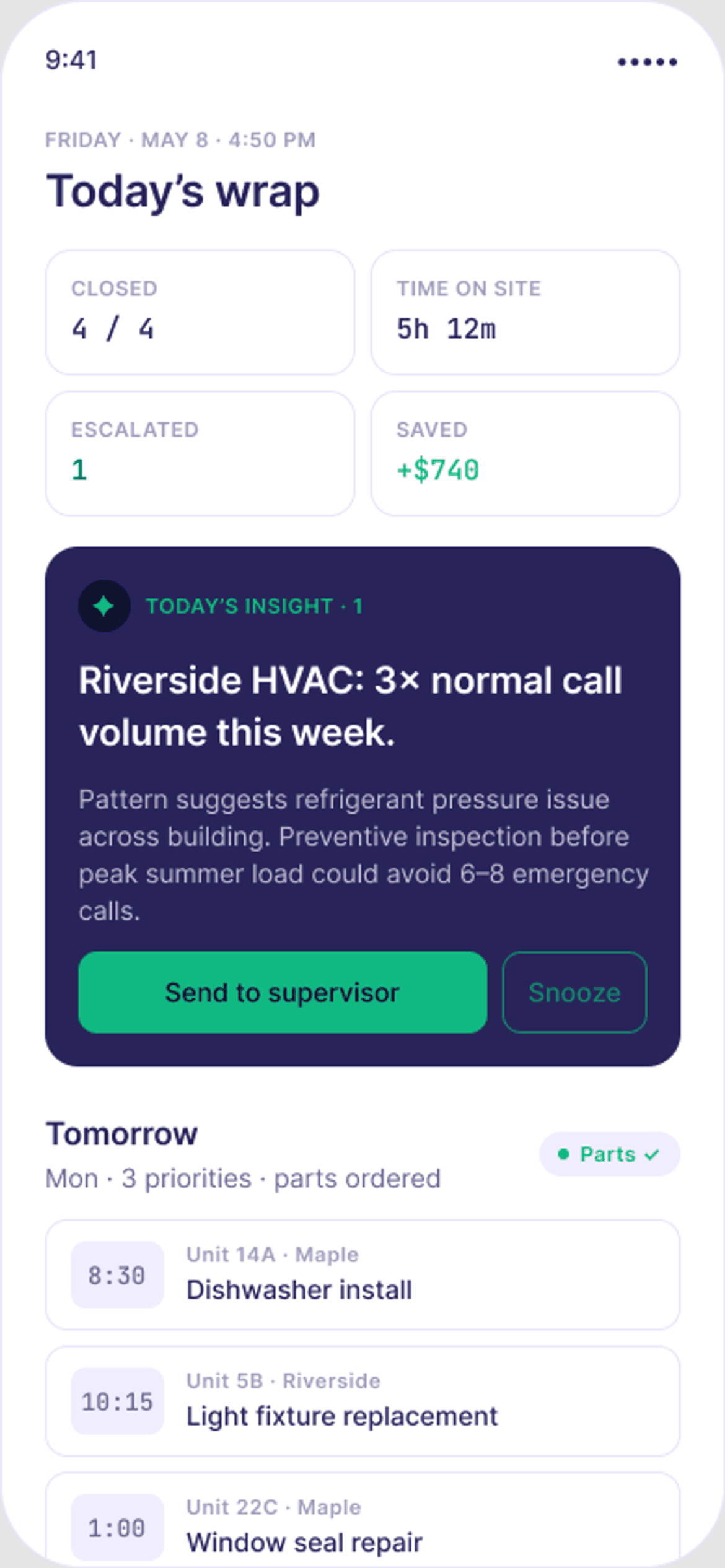
End of day, AI surfaces one insight worth escalating up the chain. Tomorrow is pre-loaded, parts ordered. Leave the day clean.
HappyCo's next AI opportunity isn't another standalone feature. It's a sharper field workflow.
JoyAI already supports key maintenance moments: intake, summaries, routing, voice-powered notes, and operational insights. I'm not proposing “add AI to maintenance.” I'm exploring what happens when the technician's in-unit workflow becomes a real-time intelligence surface.
The field is where the most valuable context is created: what the tech sees, what they try, what parts they use, what keeps repeating, and what should be escalated. Field Copilot turns that moment into structured memory the whole portfolio can learn from.
That's where repeat work gets reduced: not by treating the leak in 3B as another isolated ticket, but by catching that it is the third issue in the same vertical stack before the work order is closed.
Transparent process. No magic, just leverage.
Research, ~30 min
Reviewed happy.co for product surfaces, personas, brand language, and proof points. Mapped JoyAI's existing role across maintenance workflows and looked for a plausible extension, not a replacement.
Concept, ~45 min
Stress-tested three concepts: Field Copilot, Pattern Teardown, and Owner's Pulse. Picked the one closest to HappyCo's existing product direction and most useful for showing field-level interaction design.
Design system, ~1h
Generated 19 color tokens + 15 text styles programmatically in Figma via the Plugin API. Brand-aligned to HappyCo: navy, cyan for AI, neutrals.
5 high-fi frames, ~3h
Built each screen with auto-layout, components, and the design tokens. Iterated copy with Claude to stay close to HappyCo's tone without copying product.
Functional demo, ~3h
The Frame 2 → Frame 3 transition above is real code, not a prototype. State machine, real animations, deployed live.
This microsite, ~1.5h
What you're reading. The container is also a demonstration: same brand language, same craft, real engineering.
AI didn't make me faster at making decisions. It made me faster at executing them. Every concept, copy choice, and structural call was mine. AI handled the typing.
A focused extension of HappyCo's field intelligence layer.
This artifact documents the product rationale, persona choice, AI interaction model, and one coded moment. It's meant to show how I think, how I use AI to move faster, and how quickly I can turn a product hypothesis into something concrete.